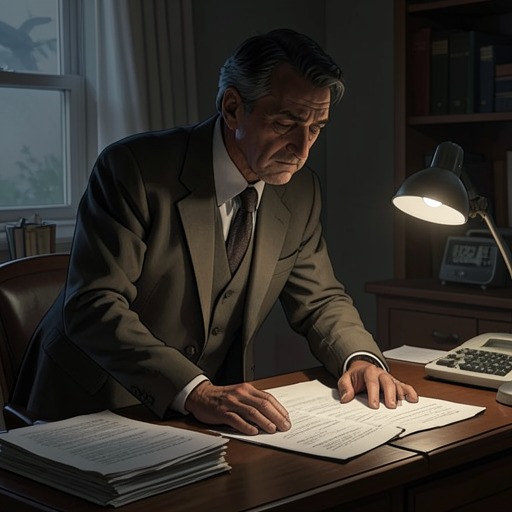
Crosbie Francis Wells birth certificate
The LuminariesThe Crosbie Francis Wells birth certificate becomes a crucial but unresolved piece of evidence in the chain connecting Francis Carver, the missing shipping crate, and the real Crosbie Wells. Carver used it to support an advertisement seeking the return of the crate, yet the document’s origin and authenticity remain unproven. It gives the name behind a transaction without finally explaining the identity that name was meant to conceal.
The Certificate at the Newspaper Office
In June 1865, a dark-haired man with a scar on his cheek entered Benjamin Löwenthal’s small office on Weld Street and asked for a notice in the West Coast Times. He said he had lost a shipping crate containing objects of considerable personal value. He offered twenty pounds for its return, or fifty if it came back unopened. Asked for his name, he did not answer aloud; instead, he took a birth certificate from his pocket and laid it on Löwenthal’s desk. The name Löwenthal recorded was Mr. Crosbie Francis Wells.
The advertiser gave an address on Gibson Quay for anyone who found the crate. He did not disclose its contents, and the certificate was presented as a way to identify him for the notice, not as an explanation of the crate itself. In the later reconstruction of events, the crate is understood to have contained a trunk and about four thousand pounds in gold sewn into five dresses. Lydia Wells had made the dresses while posing as Carver’s wife. The certificate thus appears at the point where Carver’s search for a valuable lost shipment becomes entangled with another man’s name.
A Name Restored in Print
The newspaper’s typesetting mistake made the certificate’s full name unusually memorable to Löwenthal. The advertisement was too long for the two-inch column space Carver had paid for. Its final word, Wells, would have been left stranded at the top of a third column, so Löwenthal removed the middle name Francis after Carver had left. The notice appeared the next morning without it.
Carver returned before noon and insisted that Francis be restored, without explaining why its inclusion mattered so much. He objected to the unauthorized alteration in the same gruff manner as before. Löwenthal apologized, printed the notice again, and ran it five more times during the paid week, adding a seventh printing without charge. For Löwenthal, the episode fixed both the date and the full name in memory: it was the first mistake of his newspaper enterprise, followed by a dissatisfied customer who took the error seriously.
The context of that recollection gives it a particular evidentiary weight, but not unlimited certainty. The West Coast Times began publication on 29 May 1865 with a run of twenty copies. Within a month, Löwenthal had acquired a steam-powered press; it arrived on 1 July. Because the June advertisement had been set on the old hand-operated machine, he could place it before that change. He also remembered the framed first edition hanging in his office, which helped anchor the paper’s founding date. His memory of the date and the restored middle name rested on identifiable details of his work, rather than on a document he had recently checked.
What the Document Establishes—and Does Not
When Benjamin Löwenthal recounted the episode months later, Walter Moody pressed him on how he could be sure of the advertiser’s identity and appearance. Löwenthal could explain his confidence about the date and the wording, but he conceded that he could not be certain the man had actually possessed a scar. The vivid image of the visitor pressing a top hat between his palms strengthened Löwenthal’s recollection for him, but did not independently verify it. He had never known the hermit Crosbie Wells in life and had no surviving image against which to compare the man he remembered.
The birth certificate, as described in the account, supports a narrower conclusion: a man later identified as Francis Carver presented a document bearing the name Crosbie Francis Wells, and Löwenthal remembered the middle name because its omission provoked Carver’s return. The story does not establish that the certificate was authentic, how Carver came to possess it, or whether the person named on it was the hermit living in the Arahura Valley. Walter Moody considers the possibility that Carver had stolen the certificate to impersonate Wells, but also considers that the middle name could have been added to a document later. These remain hypotheses, not confirmed provenance.
The Certificate and the Missing Crate
The advertisement belongs to a larger sequence of concealment. Carver had used the name Francis Wells when dealing with Alistair Lauderback over the sale of the Godspeed, and later used Crosbie Francis Wells when seeking his missing crate in Hokitika. The change of name raises the possibility that the certificate enabled him to pose as the hermit, but the reason for adopting that identity—and the certificate’s connection to the real Wells—remains unresolved. Carver returned to Dunedin without recovering the crate.
Walter Moody later found a bill of sale for the Godspeed among papers in a trunk marked as Alistair Lauderback’s property. The purchaser had signed as Francis Wells, with an expansive flourish on the F that could also be read as a C, and a dot that supported either Francis Wells or C. Francis Wells. Moody interpreted this ambiguity as deliberate, allowing Carver to deny having signed under a false identity. The certificate’s middle name therefore matters beyond the advertisement: it helps Moody connect Carver’s shifting signatures and names, while leaving the precise mechanics and motive of the impersonation open to investigation.
Documentary Evidence and Its Limits
At the later court proceedings, Moody compared the Godspeed bill of sale with other documents bearing Crosbie Wells’s signature. He pointed to the signature on a deed of gift dated 11 October 1865, concerning two thousand pounds to be given by Emery Staines to Anna Wetherell, and to the signature on Wells’s marriage certificate submitted by Lydia Carver. Those signatures resembled one another but did not resemble the signature on the bill of sale; Moody offered the comparison as proof that the sale document was forged.
That courtroom argument does not authenticate the birth certificate. Rather, it shows how the certificate forms one part of a wider documentary puzzle in which names, signatures, and claims of identity are tested against one another. The certificate’s force is real but limited: it links Carver to the name Crosbie Francis Wells and helps explain why the middle name became conspicuous, while leaving the document’s own history uncertain. In a story where property and identity pass through advertisements, contracts, and legal claims, the certificate is less a final answer than a trace whose meaning depends on the other records around it.